North Loop's New Park Is Named for a Pilot Who Learned to Fly Down the Street
November 5, 2026
November 5, 2026
In 1941, a U.S. Army bomber landed by mistake on the dirt runway of a small North Austin airfield and got stuck in the mud. According to retired urban planner Jim Duncan, writing in the Austin American-Statesman's "From the Archives" column, that was about the most exciting thing that ever happened at Haile Field. The field's offices and hangars stood at the end of Avenue F, where Koenig Lane meets it today.
Eighty-five years later, a new acre of public ground sits on that same stretch of Koenig Lane. Its swing set and slide went in where planes once taxied. The park on the east side of the Hangar development at 403 E. Koenig Lane is new, but the land under it is the reason the neighborhoods around it exist.
The sources don't agree on every date. The Statesman column says the airfield closed in 1947, and the North Loop Neighborhood Association's history page says 1948. Either way, the order of events is clear.
| Period | What stood at the end of Avenue F |
|---|---|
| 1938 | French Rudolph "Doc" Haile, a commercial pilot and licensed aircraft mechanic, starts a flying service |
| 1941 | An Army bomber lands on the dirt runway by mistake and sinks into the mud |
| Late 1940s | Haile Field closes, in 1947 or 1948 depending on the source |
| 1950s | The roughly 50-acre field is split into lots and blocks and sold as Skyview Homes |
| Decades after | Industrial use by Texas Gas, then an empty lot |
| October 15, 2026 | Seco Ventures previews a 1.02-acre park for neighbors |
The Skyview name came straight from the airfield. One of the Statesman's readers also remembered that a later Koenig Lane business, the Howard family's nursery, sat on part of the old field. Until that property was sold and razed, an army-style metal hangar stood there with the faded name "Ragsdale Aviation" painted on the front.
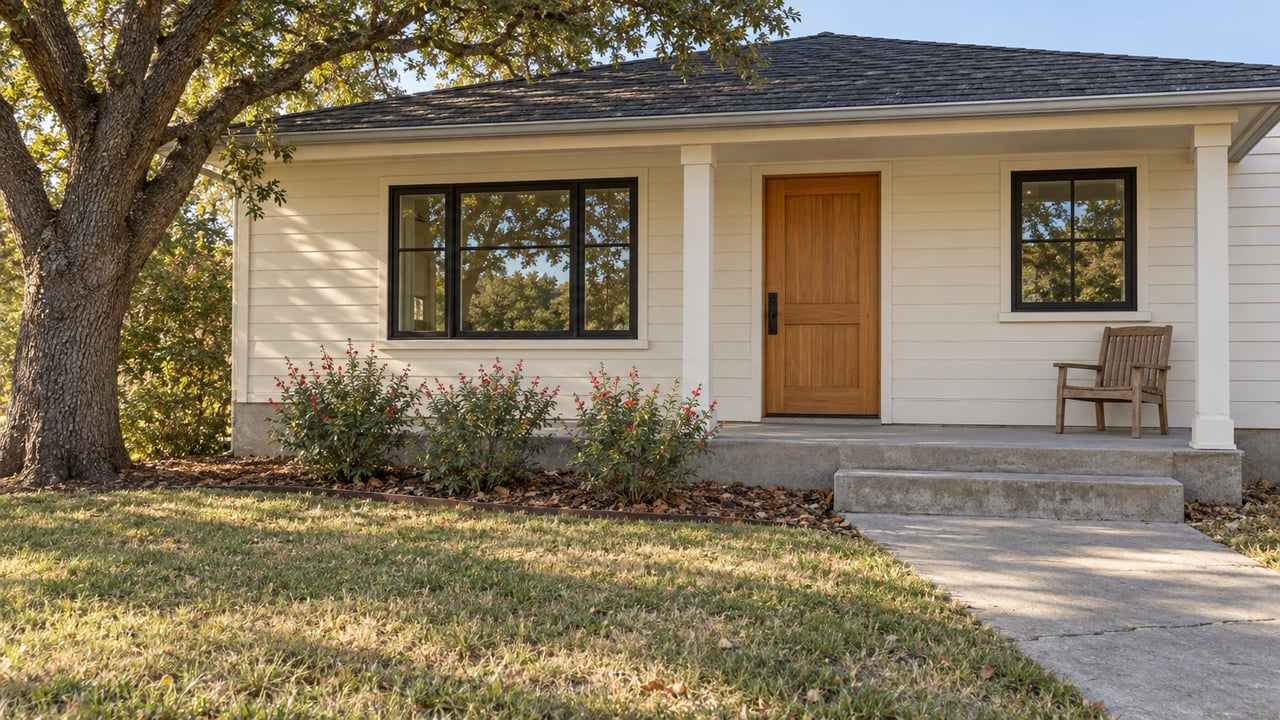
Look south of the old runway and you find the same history in the houses. The neighborhood association's history says that in 1940, most of what is now North Loop was empty land. It held Doc Haile's airport on present-day Koenig, an orchard to the south, and a few scattered houses. Most of the neighborhood, first called Northfield, went up right after World War II. Returning soldiers needed affordable family housing near the University of Texas, and developers like J. S. Whitney sold lots in the Northfield Addition for as little as $150.
The houses were small and built fast. The association describes the typical plan as 800 square feet with two bedrooms and one bath. Foundations were local cedar posts cut to length with the bark still on, usually set only about six inches into the ground. The oak tongue-and-groove floor was nailed straight onto the beams, usually with no subfloor. The same history credits the materials of that era for how well these houses have lasted, including hard old-growth pine walls and straight, strong roof decking. That is a familiar pattern to anyone who has opened up a postwar Austin wall.
Those houses filled in under working air traffic. The association notes that with Haile Airport on the north edge and Austin Air Service flying from a field to the east, "planes were flying over Northfield long before it was a neighborhood." The noise also outlived Haile Field. Robert Mueller Municipal Airport sat a little more than two miles southeast and stayed open from 1930 until 1999. The Statesman's columnist recalls jets coming in low over Skyview on their approach to Mueller as late as the 1980s.
So the new park gives the neighborhood something it hasn't had at that spot in a long time. After the hangars came decades of industrial use, then a lot nobody could use. Chessie Lockhart, president of the North Loop Neighborhood Association, told KVUE: "I don't think you get more facelift than turning an abandoned parking lot into this incredible public city park."
According to Community Impact, the park covers 1.02 acres. It has a sports court, shaded areas, a heritage oak, a children's playscape, and a 3,000-pound play slide. The paper's headline calls the court a pickleball court, but the article itself only says "sports court." Plan to find out what the lines are for when you get there.
The airfield story shows up again on the mural. Venezuelan artist Luis Angulo, who works as ULOANG, spent about four weeks painting a 50-foot mural on the first building. It shows a young woman of today walking through North Loop past a vintage shop. She wears a bomber jacket like the ones World War II pilots wore, an Army Air Corps jacket that Community Impact says the park's namesake could have worn in the 1940s.
That namesake is Mildred "Millie" Inks Davidson Dalrymple. She took flying lessons at the North Loop airfield and went on to join the Women Airforce Service Pilots. In 2010 she received the Congressional Gold Medal for her wartime service. Her son, Tom Dalrymple, told KVUE the dedication came as a surprise: "Very flattered, very honored, but we had no idea that this happened."
The name on the sign is still open. Community Impact refers to the park as "Millie at Hangar." KVUE reports that "Millie at The Hangar" is the name of the first apartment phase and that the park has no official name yet. Either way, the Millie name is on this corner.
Seco Ventures worked with the North Loop Neighborhood Association for several years on the park and the apartments. Brian Bedrosian, an association member, described those talks to Community Impact:
"We spent over a year in negotiations with the developer and those negotiations were not in an effort to minimize or shrink this project into something that neighbors could swallow. It was an effort to create a project that… that we could celebrate and champion."
The October 15 event was a preview for neighbors, with food from local vendors and a DJ set from Breakaway Records. Council Member José "Chito" Vela spoke, along with neighborhood representatives. The Red Line Parkway Initiative set up a table alongside the North Loop and Skyview neighborhood associations.
The next step is a transfer of ownership. Jeff Stewart of Seco Ventures told Community Impact the developer would hand the park to Austin Parks and Recreation in late October. The City then opens it to the public, and the developer announces the official opening. Until that announcement, the final landscaping and planting are what stand between the preview and an ordinary Saturday visit.
Once it becomes City parkland, the general rule in the City's park directory applies: parks are open 5 a.m. to 10 p.m. unless signs at the park say otherwise. The apartments are on a separate schedule. KVUE reported the first tenants were expected in mid-to-late November, and the project's own site lists a 2027 opening for the full development of 464 units.
The park sits beside the Red Line tracks, but there is no rail-side trail at Koenig yet. CapMetro's 2024 alignment study puts the corridor from East 45th Street to south of Highland in its most constrained category and notes steep slopes near Koenig. The City's Urban Trails page lists no finished Red Line Trail segment here. For now, Airport Boulevard is the easier way to move around on foot or by bike. The City finished a west-side shared-use path between 51st Street and Middle Fiskville Road in early April 2026, as Community Impact reported.
Here is one loop, from the closest stops to the farthest:
If you ride the whole loop, you cross the postwar Northfield blocks, built when Doc Haile's planes still flew overhead, on your way back to the acre where they took off.
If you own a Northfield or Skyview house from those first postwar years, its frame tells part of this same story, from the cedar posts underneath to the oak floors with no subfloor. If you'd like an architect to look at what your house was built with and what it can handle next, Ed Hughey is glad to walk through it with you. Let's Connect.
Stay up to date on the latest real estate trends.

Working with Ed means partnering with a real estate professional who brings a strategic, design-informed approach to buying and selling homes in Austin. As a licensed Realtor with a deep understanding of residential construction, renovation potential, and city code, Ed helps clients identify value, assess opportunities, and make confident, informed decisions in a competitive market. Known for clear communication, honest guidance, and strong negotiation, Ed is committed to protecting his clients’ interests while delivering a seamless, results-driven real estate experience from start to finish.