Northwest Hills Austin Home Prices: What Drives Value
August 13, 2026
August 13, 2026
Pull up three different market reports for Northwest Hills this summer and you will get three different neighborhoods. One says the median home sold for $758,000 in March 2026. Another, using trailing twelve month data through August 2026, puts it at $1.2 million. A third lands in between. Same neighborhood, overlapping time windows, a spread of nearly half a million dollars.
None of these numbers is wrong. That is the part buyers and sellers usually miss. Northwest Hills is not a market where one clean median can describe what is actually for sale, and understanding why changes how you should shop it.
Here is what the reports actually show, side by side.
| Source window | Reported median | Sample size | Days on market |
|---|---|---|---|
| Single month, March 2026 | $758,000 | 26 closed sales | 62 |
| 30-day snapshot, spring 2026 | $970,000 | 11 closed sales | 15 |
| Full-year 2025 aggregate | ~$850,000 | 142 closed sales | 56 |
| Trailing 12 months, as of August 2026 | $1.2 million | 88 closed sales | 51 |
Price per square foot tells the same story. Depending on which report you read and which month it covers, that figure lands anywhere from $315 to $425. A $110 per square foot swing on a 3,000 square foot house is $330,000, more than most buyers' entire down payment.
And it gets stranger. Some of these reports track the specific Northwest Hills neighborhood boundary. Others track the broader 78731 zip code, which also bundles in Highland Park West, Cat Mountain, and Balcones Woods. Pull the trailing twelve month figure for the full zip code instead of the neighborhood alone, and the same window that produced $1.2 million for Northwest Hills proper produces $1.21 million to $1.25 million once those adjacent areas are folded in. Even the boundary you draw around the neighborhood changes the answer.
This is not several analysts disagreeing about the same houses. It is several analysts describing different slices of a market that does not produce enough transactions in any given month, or within any single boundary, to smooth itself out.
A median only works as a shorthand when you are averaging a lot of similar things. Northwest Hills fails both conditions. The neighborhood closes somewhere between 11 and 26 homes in a typical month, with troughs of 6 to 8 closings in December and January and a spring surge of 16 to 18 in May and June. When your sample size is that small, a single unusual closing (one $2.2 million gut renovation, or one $800,000 original-condition estate that needed everything) can move the reported median by tens of thousands of dollars on its own.
Compare that to a neighborhood with a deep, uniform housing stock. If 150 nearly identical townhomes sell in a month, the median is a real number you can trust. If 11 homes sell and they range from a 1960s ranch that hasn't been touched since Carter was president to a 2024 rebuild with a wine room, the median is just whichever house happened to land in the middle of that particular month's list. Change the month, change the middle house, change the number.
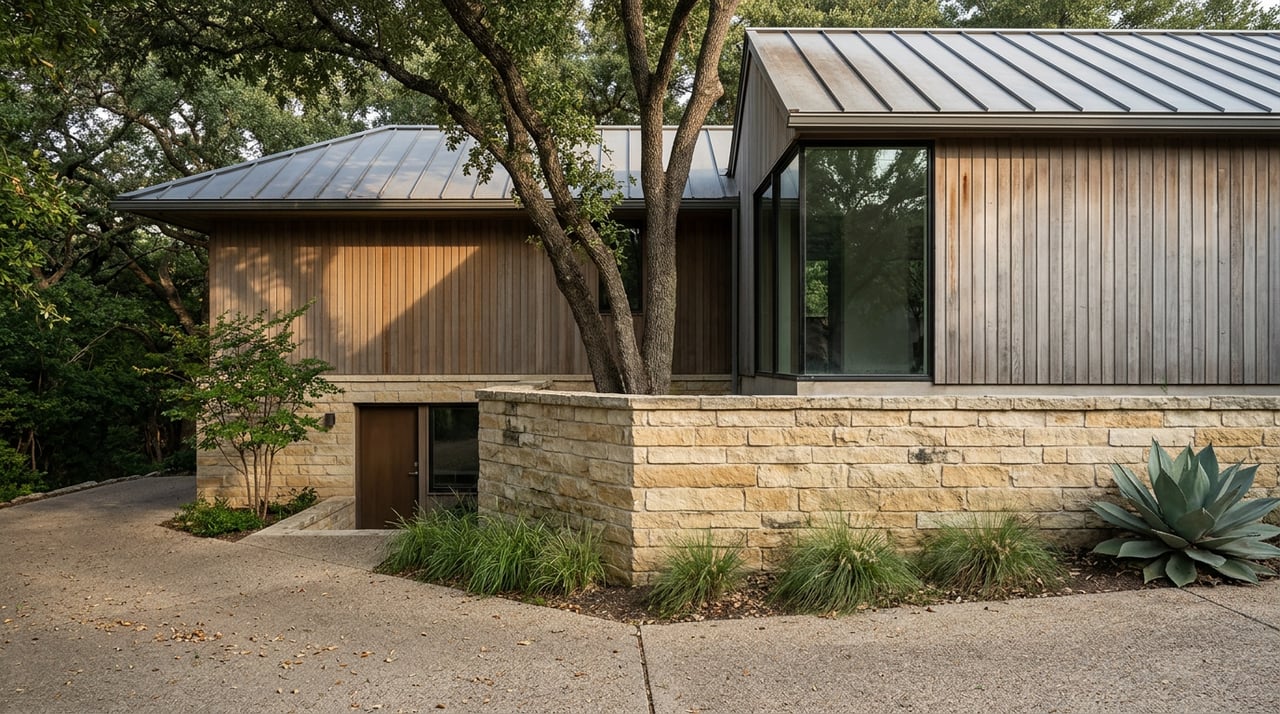
The reason the mix varies so much month to month is that Northwest Hills was never built as one product. Travis Central Appraisal District records and Texas Real Estate Research Center data both point to roughly five distinct construction eras sitting on the same streets: 1960s ranches built directly into the original platted hillsides, 1970s contemporary homes with vaulted ceilings and hillside placement, 1980s traditionals, 1990s executive expansions, and a smaller wave of post-2010 modern infill and full rebuilds.
Of those, the 1970s contemporary cohort tends to move fastest, largely because it pairs the neighborhood's strongest architectural character with the most accessible price point in the upscale tier. That is a meaningful detail for a design-minded buyer. Vaulted ceilings and abundant glazing were not accidents of the era. They were a direct response to the terrain, and homes that lean into that response tend to show better and sell faster than ones that fight it.
Era explains part of the spread. Condition explains the rest, and the gap inside a single era can be just as large as the gap between eras. Original-condition 1970s and 1980s homes have been trading in roughly the $295 to $315 per square foot range. Partially updated homes, meaning a refreshed kitchen and baths without a full gut, land closer to $330 to $350. Fully renovated or modernized homes are pushing past $400 per square foot, a 20 to 30 percent premium over an original-condition home of the same age and size.
That premium is not paint and countertops. Many original 1960s and 1970s houses here still need electrical panel and HVAC modernization to perform the way a modern buyer expects. On a sloped lot, the calculation gets one more variable: some of these homes were designed with split entries or partial lower levels that walk out to grade, which adds genuinely usable, daylit square footage that a flat ranch simply cannot replicate. Two houses can share an identical square footage figure on paper and still be entirely different products once you account for how that square footage is arranged against the hill.
This is also why price per square foot is a weaker tool here than it would be in a newer, flatter subdivision. Land, view, and slope carry more of the value in Northwest Hills than the building itself does, and none of that shows up in a per-square-foot number.
For the buyer weighing an original-condition home against a turnkey one, the numbers work out roughly like this based on recent local remodel activity:
None of that math works if you are anchoring to a single neighborhood median. It only works if you know which era and condition tier the specific house belongs to, and what that tier typically requires to reach turnkey.
The practical takeaway is simple. Stop asking whether a listing is above or below "the median" for Northwest Hills, because there isn't one stable number to measure against. Ask instead which era the house belongs to, where it sits on the condition spectrum within that era, and what the lot and slope are doing to the usable square footage. Those three answers tell you more about fair value than any citywide or zip-code aggregate will.
If you want the fuller due diligence checklist for evaluating one of these hillside lots, from drainage and retaining walls to framing quality and tree canopy, I put together a companion guide on Northwest Hills hillside living and what to check before you buy that walks through it room by room and system by system.
Is Northwest Hills a buyer's market or a seller's market right now? Zip-code-wide inventory for 78731 was running under four months of supply as of mid-2026, tighter than a neutral market but looser than the multiple-offer conditions of a few years ago. Days on market for the neighborhood itself have run in the 51 to 62 day range across recent windows, with updated homes generally moving faster than original-condition ones. That gap between fast-moving renovated homes and slower-moving original stock is part of why the reported median swings so much depending on which category closed in a given window.
Why do two homes on the same street have such different prices per square foot? Usually some combination of construction era, condition, and how the floor plan responds to the slope. A 1970s contemporary with a walk-out lower level and updated systems can carry a real premium over a 1980s traditional of the same size that has not been touched since it was built.
How much should I budget beyond the purchase price for an original-condition home here? Recent local remodel activity suggests $200,000 to $400,000 for a meaningful renovation, with specific line items like kitchens, baths, windows, and any foundation or hillside stabilization work varying widely by scope. Get a contractor's eyes on the specific slope and structure before you finalize a budget.
If you are trying to make sense of a specific Northwest Hills listing against this kind of shifting data, that is exactly the conversation Ed Hughey is built for. Let's connect and look at the actual house, not just the number attached to it.
Stay up to date on the latest real estate trends.
Working with Ed means partnering with a real estate professional who brings a strategic, design-informed approach to buying and selling homes in Austin. As a licensed Realtor with a deep understanding of residential construction, renovation potential, and city code, Ed helps clients identify value, assess opportunities, and make confident, informed decisions in a competitive market. Known for clear communication, honest guidance, and strong negotiation, Ed is committed to protecting his clients’ interests while delivering a seamless, results-driven real estate experience from start to finish.